Cuba
A Modern Model of Organic Farming and Urban Agriculture
by Holly Madrigal
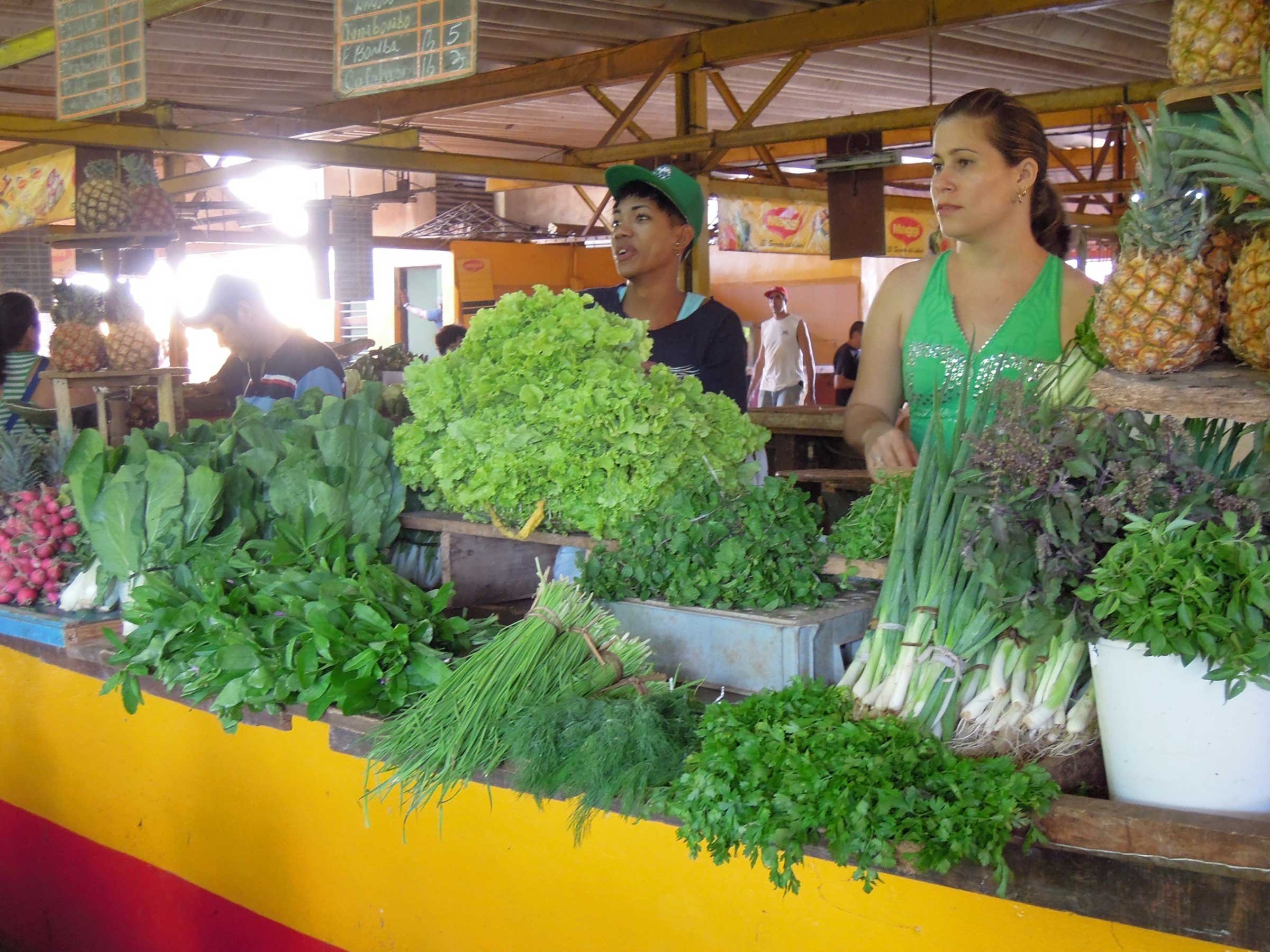
An open-air market in Havana
Editor’s note: On the ten-year anniversary of Word of Mouth, we’re thinking a lot about how things change in the course of a decade. We like to highlight how people adapt to difficulties as their conditions change. But we don’t want to gloss over the fact that sometimes, life is not just hard, it’s cruel. We are sobered by the optimism we enjoyed ten years ago when this article was published in our inaugural issue. It’s by our publisher Holly Madrigal, about a trip she took to Cuba, and the farmers and farms she encountered there. At the time, it looked like relations between our two countries were warming. Cubans were working collaboratively on organic farms, innovating, and cautiously considering the possibility of trading goods and knowledge with the US. We’re running Holly’s article again, with a few updates from Jennifer Ungemach, a former Willits resident who was a tour guide for Holly’s trip in 2013.
Cuba is sometimes called the “Accidental Eden,” because dramatic political conditions have shaped this small island into a beacon of organic agriculture. Over the past fifty years, Cuba has been under a trade embargo from the United States. Despite being ninety miles off the coast of Key West, the country has been off limits to America for both tourism and trading goods. Under the rule of President Fidel Castro, the country became heavily involved with its communist partner, the Soviet Union, importing much of its food, oil, and necessities while continuing to export sugar, the primary historical production crop. When the Soviet Union collapsed in the 1980s, this small country, deprived of outside imports, was plunged into what is called the “Special Period.” Many Cubans faced starvation, and sweeping land reforms were enacted to convert arable land to food production.
Since almost all fuel was required for other government priorities, organic farming increased because chemical fertilizers were not available. Now, more than a decade after this crisis, Cuba has emerged as a model of urban agriculture, organic farming, and cooperative work arrangements. Recently, some restrictions have been relaxed. In 2013, working with the Center for Global Justice and the Organic Consumers Association, my husband and I received educational visas to visit Cuba and to learn about their agricultural renaissance.
Leaving the airport in Havana, we were faced by an enormous billboard: “BLOQUEO, el genocidio mas largo de la historia.” Translated, it means, “the American Blockade, the longest genocide in history.” While the Cuban people suffered starvation in the nineties, they received no assistance from their neighbors to the north.
Our sponsor in Havana was the Martin Luther King Center, which is led by Reverend Raul Suarez and serves as a church, an educational center, and a community hub. The Center offers courses in popular education and community organizing. One of the many services it provides the community is free potable water in its courtyard. The neighborhood residents come and go throughout each day, filling their water bottles for home use. As travelers, we found this filtered water to be invaluable.
Our tour group was a diverse mix of farmers, agricultural and political students, and just interested Americans. Two women in the group were finishing their PhDs. One studies agro-ecology in Ecuador, the other works with Afro-Indigenous communities in rural Mexico. One gentleman has studied Cuba for decades and used to publish a Cuban literary magazine. He now farms, using literal horse power, in upstate New York. Our American guide, Jennifer Ungemach, previously lived in Willits, California. For three years she studied with John Jeavons at the Ecology Action Mini Farm. She has since fallen in love with a Cuban man, and they and their small child now live in San Miguel de Allende, Mexico.
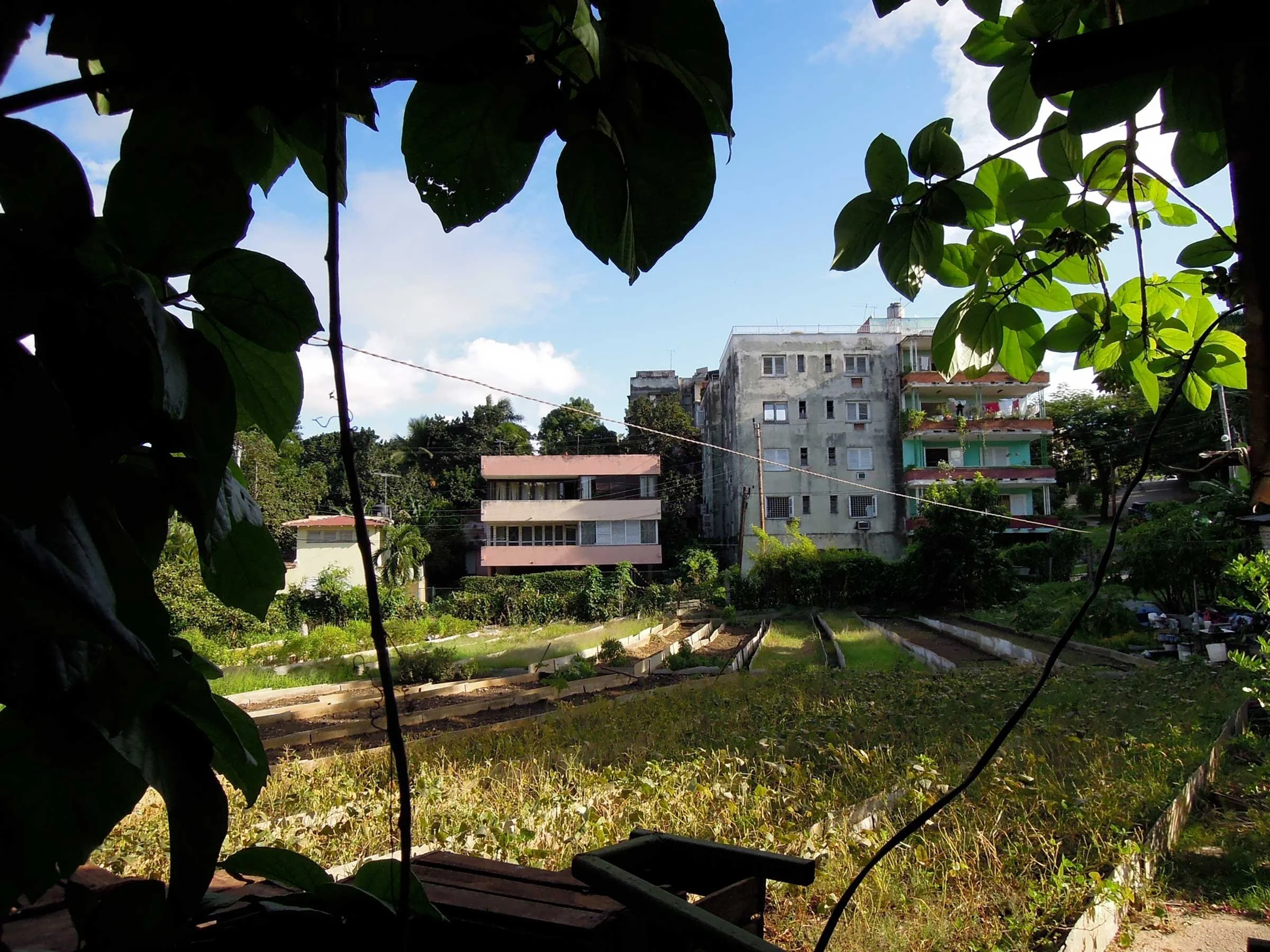
Jésus Sanchez, the owner of the Garden of Eden Permaculture Project, grew up in Havana and remembers his neighborhood as a paradise. But when he returned to his family home, he found it badly polluted by a chemical plant and metal foundry located nearby. Rather than abandon his memory of how it used to be, he set about rehabilitating his small piece of land. Raising fish in large pools, he uses the overflow water to fertilize his produce garden. He and his family grow many crops, including avocados, Barbados cherries, and mangoes. He says he prayed to God about staying in Cuba (much of his family has emigrated to the States) and chose to stay and rebuild his family homestead. He believes God answered his prayers by providing a freshwater well in the courtyard. Some members of the neighborhood call him crazy, but those same people then come purchase his fish for dinner. He has reclaimed a bit of the paradise that he remembers. He plans to expand the garden and to continue teaching permaculture methods to local children through tours and activities.
On another farm, we meet Quintero, who has one of those faces that has known many smiles. His eyes are proud as he gives us a tour of his small, two-hectare farm in Guanajay, near San Antonio de los Baños. Formerly a chemical engineer by trade, he has developed his farm using entirely organic and permaculture principles. He says that, when he started, he often got into arguments with his professional colleagues who thought that raising large mono-crops using chemical fertilizers was the only way to grow food. Persevering, he has planted a small banana plantation with shade-loving coffee bushes growing beneath the canopy. When the large leaves from the banana fall, he stacks them at the base of the plants to compost and provide additional moisture.
The challenge with water is constant. Quintero has developed a drip irrigation system, but issues with the water supply have caused him to struggle with its efficient implementation. Among the bananas, a flock of sheep grazes happily, “fertilizing the farm,” he says, with a smile. Quintero says that he needs to reinforce the sheep’s small nighttime barn. I ask him what predators he is trying to keep out, mentioning the coyotes in northern California that harass livestock and kill sheep. He says, “No, here in Cuba our coyotes walk on two legs.” Lunch is beans and rice, cucumber tomato salad, yucca, and roast pork. As we gather beneath the palms, he chops open some coconuts for us to drink, and we toast this man’s amazing accomplishment in stewarding his beautiful farm.
Just outside of Havana lies Organiponico Vivero Alamar, an eleven-hectare cooperative, all-organic farm. The scope and success of this project is astounding. One hundred and seventy two owners share the management and profits of the farm operation. Medardo Naranjo Valdes, engineer and director of “Beneficial Insects and Biologic Controls,” says that locals thought they were nuts when they began Alamar. The core group had to lure people to come work in the fields. As in the United States, farmworkers, or “campesinos,” are considered “low” in the hierarchy of community life. The group drew people by paying highwages and offering flexible hours. Every owner-member receives a share of the profits. People have different tasks depending on their strengths. A minimum-wage job in Cuba earns about 200 CUC (Convertible Cuban Pesos) a month. The workers at Alamar get 400 CUC a month, and directors get 700 CUCs a month. Each day the revenue is tallied, and 70% is distributed, while 30% goes into the bank account.There are accountants and payroll managers, people in charge of the cattle, of the medicinal plants, of the sugar cane fields, of the ornamental plant nursery, of the farm and the produce stand. One owner, now in his eighties, says he loves to come to work to oversee the garden. He feels useful and it keeps him young. The group gathers once a year to elect the governing committee and make collective decisions. The Alamar project is supported by the Cuban government, which gave it the land to start the farm. Alamar is one example of a cooperative structure that is widely practiced in Cuba, not only in farming, but also in business enterprise. Since its beginning, the farm has expanded. Bringing tours of students in from around the globe has allowed the Alamar owners to share their knowledge and success with the world.
The people of Cuba are generous, highly educated, and tenacious. Also evident however, is their weariness of the embargo and the political posturing of our two governments. “We live the embargo every day,” says Daisy Rojas, one of the founders of the MLK Center. “This is not an abstraction to us,” she continues. “When my daughter needed medication for an eye disease we could not get it because the US is the only place that makes this medication. At the same time we have made advancements in the treatment of meningitis and other medical treatments that we would like to share with the US if trade was resumed.” When asked if some of Cuba’s advancements were due in part because of the embargo, not just in spite of the embargo, Rojas is emphatic: “I credit the embargo with nothing. We as a country should be allowed to make our own decisions when it comes to our governance, with foreign investment, with trade ... It should be our choice. I trust our leaders and our community to do what’s best for Cuba.
”As our two countries navigate an uncertain future, I treasure the chance I had to explore this “Accidental Eden.”
Originally published in Summer 2016 Issue of Word of Mouth.
photos by Holly Madrigal
Cuba Then & Now
by Jennifer Ungemach
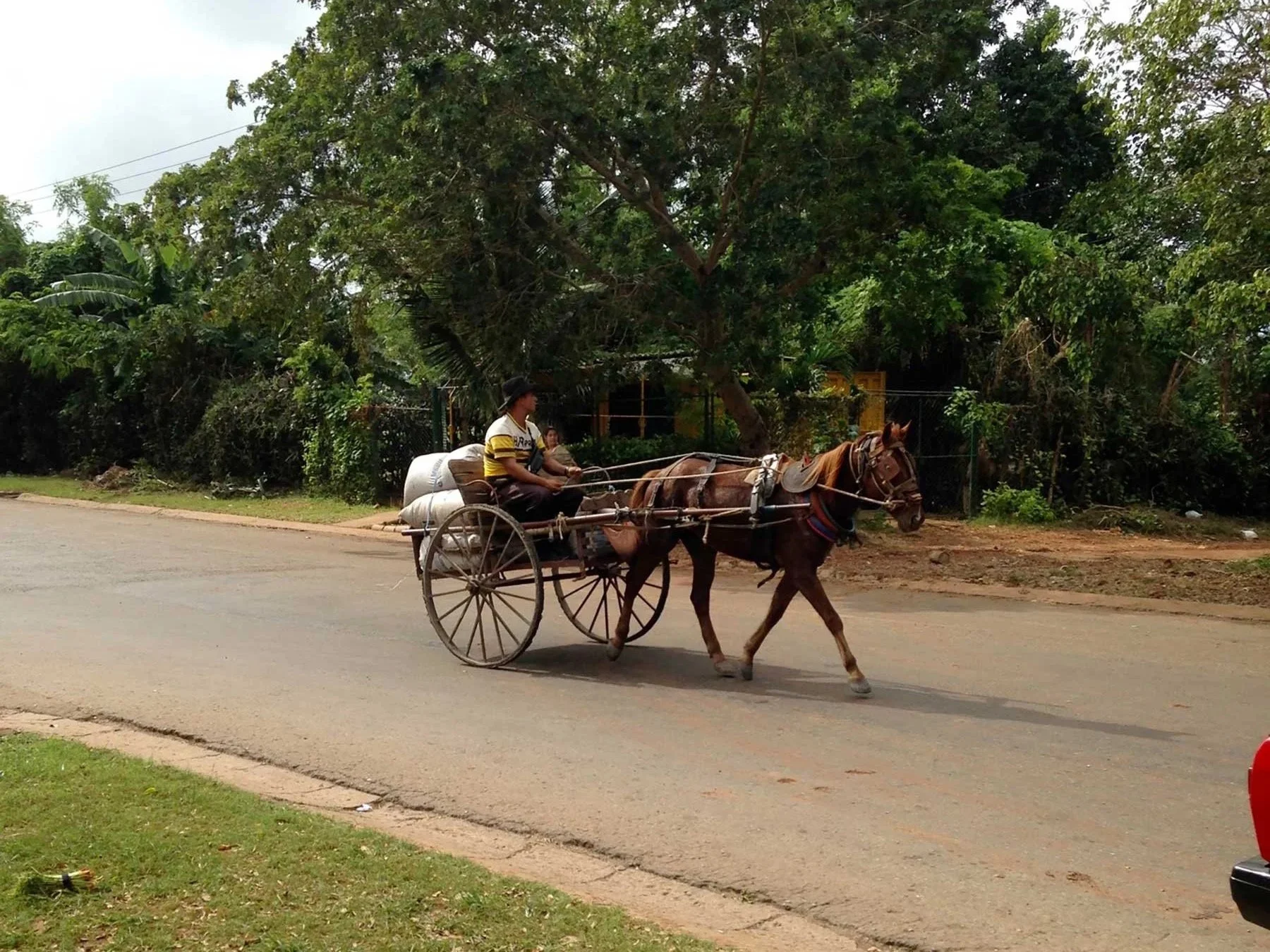
Most petrol in Cuba has been prioritized for government use. A horse-drawn cart gets the job done.
I met Holly Madrigal ten years ago when she visited Cuba to learn about how US policy intersected with the complex Cuban reality. Part of that trip included exploring efforts to localize food production within urban settings and without chemical inputs—an initiative that grew in large part out of necessity from the “Special Period”—the years that followed the collapse of the Soviet Union that forced Cuba to reshuffle its economy.
Funny enough, my path had never crossed Holly’s in the three years I called Willits, California, my home. I was working at Ecology Action, digging into concepts and realities of small-scale biointensive nutrient recycling food systems. I relished grappling with the big questions of resource management and living simply while replenishing the same land that fed us. I grew my own food and worked hard to craft a diet based from the garden and other local sources.
My life path included five years in Cuba, where I developed an interest in their food systems. I’ve lived in Mexico for the last 15 years, where I work for a US organic certifier from my digital office. Up until December 2019, my husband and I traveled back to Cuba every year to visit his family.
As an island under blockade by the United States, all of the reasons to create local food systems are amplified. Every mistake in resource management is critical and can become the “straw that broke the camel’s back.” Ten years ago, US-Cuban relations had been relaxed, allowing for sanctioned trips to the island with an educational visa. More recently, the United States position has initiated a severe international pressure campaign to cut off all oil to the island. Cubans today spend hours waiting in line for basic foodstuffs, while scrambling to conduct daily life chores without transport or electricity for long periods.
Northern California inspired me with so many examples of joyful, resilient food systems. Word of Mouth celebrates so many of those. Please keep up that good work. And reflect on what those initiatives would have looked like if they had grown out of duress—punishment by a foreign superpower—instead of celebrated as regional treasures.
Jennifer Ungemach currently works for organic certifier Oregon Tilth and ponders sustainability issues from San Miguel de Allende where she lives with her husband, 13-year old son, 2 cats and an energetic Jack Russell.
photos by Holly Madrigal
