Shadecloths and Salt Tolerance
Researching Grape Growing for a Warmer World
by Christopher Chen
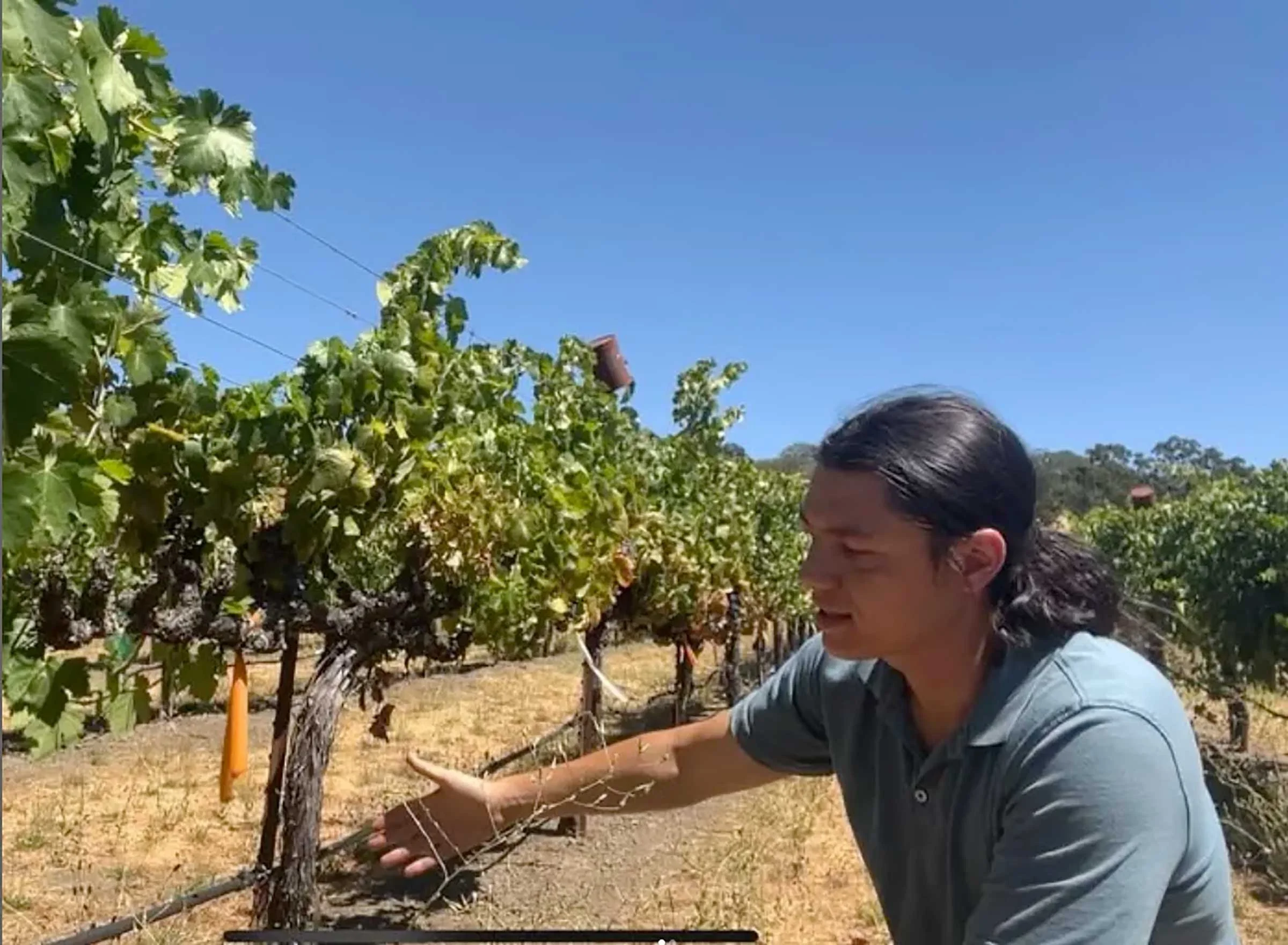
Christopher Chen conducts research in a Mendocino County vineyard.
I ended up in viticulture through my love of economics. During my early student years at U.C. Davis, I started off studying economics and enjoyed it so much I almost finished my bachelor’s degree in two years.
I wanted to stick around college longer, so I added Horticulture as a second major. Plants appealed to me for a couple of reasons. First, I like to be outside in nature and go hiking. Second, I have fond memories of helping my grandmother in her rose garden when I was a young child. I had always found time with plants relaxing, and it was fun to learn how they function.
These two interests led me to my current position as the University of California Cooperative Extension’s (UCCE) Integrated Vineyard Systems Advisor for Lake, Mendocino, and Sonoma counties. In my research I have always looked for solutions to sustain viticulture in the face of a changing climate. Initially, I worked on mitigating sun exposure damage using shade netting. This was in Dr. Kaan Kurtural’s lab at UC Davis in conjunction with post-doctoral researchers, Luca Brillante and Johann Martínez Lüscher. The experience taught me how to properly design experimental field research and what parameters are most useful for winegrape production.
My doctoral work with Dr. Andy Walker at UC Davis focused on identifying salt-tolerant grapevines. These could be used as rootstocks in regions where limited groundwater and prolonged droughts result in irrigation water with high salt content. Today my research continues along the primary thread of climate acclimation for vineyards. My most recent work identifies rootstock varieties that are able to recover from multi-year drought conditions and the smoke-taint risk associated with prescribed burns occurring near winegrape vineyards.
Much of the time, the results of my research align with the intuitions of the grape growers. During the drought-recovery rootstock study, the rootstocks that performed best after prolonged drought were those that were already favored by grape growers in the North Coast region of California. Often a study’s data supports the viticulturists’ knowledge and explains why their decisions work so well in practice.
There are plenty of issues to investigate when it comes to viticulture and climate change, which I categorize as direct and indirect challenges. Direct challenges are climate change consequences that impact grapevines. Indirect challenges affect other aspects of the environment that, in turn, shape the viticultural growing conditions.

Direct challenges include heat, precipitation, and water, both in terms of its availability and its quality. Average ambient temperatures have increased at least 2oF in the past 40 years, and heatwaves are becoming more frequent and severe. This leads to water stress, heat damage, sunburn, and other issues in the vines.
Wine grapes are typically grown in Mediterranean climates, which are prone to hot and dry summers with precipitation primarily occurring in autumn and winter. In California, precipitation is not guaranteed and the state can go many years in a water deficit because of this.
With changing climates, we expect precipitation patterns to shift, but we are limited in estimating exactly how that will happen. In some places rainfall might increase while a neighboring valley suffers prolonged drought. It is difficult to prepare for a shift in environmental conditions if you don’t know what those changes will be. In contrast, we do know that ambient temperatures will rise across the board and so can prepare for that accordingly.
Changing precipitation is a factor, as is the quality of the water that irrigates vineyards, whether it is sourced from the sky or under the ground. Overdependence on groundwater for irrigation may deplete aquifers faster than they are replenished, increasing the concentrations of whatever dissolved solutes are in the water. In some places, this would mean ever-increasing soil salinity. Other regions might experience higher nitrogen levels if that element has leached down into the aquifer.
When it comes to indirect challenges, I’m especially concerned about the migration of pests and diseases to new regions. As both summer and winter temperatures rise, the suitability of a region for a specific pest might also improve. That would mean that insects like glassy-winged sharpshooters could survive over winter in a region where, in previous decades, they would have been wiped out every year. Pests might also acclimate to new ambient conditions by shortening or modulating their developmental stages to earlier in the season, increasing the amount of time they impact the growing season.
There may be other resource concerns which place additional strain on farming practices. The cost of fertilizer, pesticides, and fuel have risen rapidly recently. These are essential inputs for production agriculture as a whole. As they become more costly to obtain, maintaining a profitable farm will become more difficult.
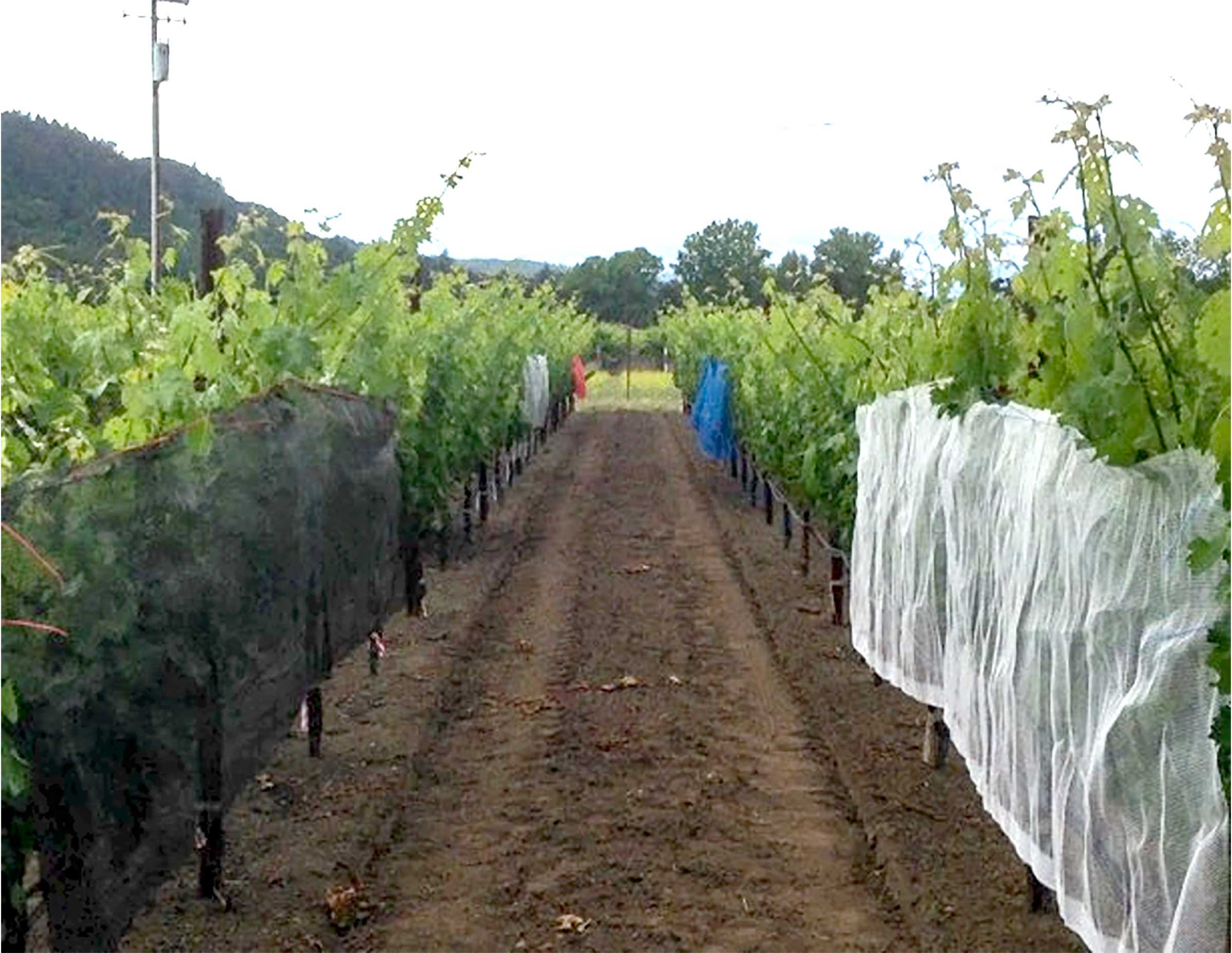
The wide-ranging studies I’ve conducted or assisted on have resulted in key findings that could be useful if applied correctly in practice. For example, researching shade nets showed a near elimination of sunburned fruit under black shade nets with 60% light transmission when compared with a control. This helps quite a bit with the expected changes in ambient temperature to come.
A recent paper coming out of Dr. Luis Diaz-Garcia’s lab at UC Davis helped identify the chromosome(s) which are associated with the trait of salt tolerance in grapevines.This is a huge advancement towards the development of a salt-tolerant grapevine rootstock cultivar.
A study that examined drought recovery for different rootstocks identified modern grapevine rootstocks that are great at recovering from prolonged droughts—six years in this case. Another study measured when and where temperature inversions occur in Lake County, utilizing a design for a temperature inversion tower by former UCCE advisor Mark Battany. The purpose of the study was to identify vineyards where frost fans could be used in place of overhead irrigation to conserve water for the annual movement of the Clear Lake hitch fish species in Lake County, particularly during drought years.
Looking to an uncertain future for our climate, there are three measures I recommend to all vineyard owners. First, create efficient systems for your irrigation, fertilization, soil amendments, and other processes to ensure they are applied efficiently and properly. If you tend to “just figure it out” every year, it is probably time to start developing a functional system that has set objectives and timepoints for those objectives. This also means regular maintenance of the irrigation system, spray rigs, compost spreaders, and other infrastructure and machinery.
I also recommend that you monitor for pests, diseases, and vine health, which are all going to become more important as new environmental conditions change the resource demands for our vineyards. With prolonged drought, for instance, it might be good to keep track of the water levels of your vine and soils more often. Look out for populations of pests and diseases that you know exist in your area, but also for new pests and diseases that may move into it.
Lastly, try new things on small scales. Sometimes I recommend that a replanted vineyard try new grape cultivars in a small area to see how they perform. In 20 years, the climate where we grow Pinot Noir may no longer be suitable for that varietal, and another cultivar that is more heat tolerant may need to replace it. Having a “test row” will help you make future decisions around replanting.Apply this same approach with new trellising or irrigation schedules as well. Don’t try to change everything in the vineyard all at once. Instead, test it out for a year or two in a small area first. Then you can implement or adjust it to improve the outcome before introducing it vineyard-wide.
The most challenging part of my position is being unable to assist my clientele with economic hardships the way I can with practical vineyard management. While I have a background in economics, there is little I can advise on when it comes to global and local wine and grape markets. I have done my best to provide tools to address their economic concerns and in that spirit, I have just released a new website for Vineyard Management Cost Estimation. It is now available for publicly submitted, crowd-sourced data input. You can find that website at uccevineyards.neocities.org.
My favorite part of my job is the opportunity to learn more about vineyard management and practical vineyard skills from both viticulturists and vineyard managers. I have a good amount of knowledge in general plant science and grapevines specifically, but that information does not always include what is actually practical in a real-world setting. Learning from grape growers has helped me become much better at my craft and a much more reliable source of information for my clientele. Our combined expertise can help the wine industry and the vineyards on which it relies be better prepared for the changing climate.
Find out about Chris Chen’s work at ucanr.edu/site/ucce-north-coast-viticulture.
Use his estimator tool at uccevineyards.neocities.org
Chris Chen is the Integrated Vineyard Systems Advisor for UC ANR and assists grape producers in Sonoma, Mendocino, and Lake County.
photos courtesy of Christopher Chen, PhD
*Source: https://www.frontiersin.org/journals/plant-science/articles/10.3389/ fpls.2020.579192/full
