The Why of It
Life is Warmer with the Rhythms of Wool
by Gowan Batist
My big Jensen spinning wheel makes a rushing sound like the moment when kindling ignites, a low whoosh that hums in the cozy winter living room, gathered around the crackling wood stove. The pedals move slowly, the miracle of transfer of momentum moving the cherry wood wheel much faster than the sedate pace of the pedals. When I spun yarn on this wheel, sitting on a birth ball waiting for labor to begin, the wriggling baby in my belly would calm. After they were born, I would lay the baby in my lap as I spun, gently rocking them to sleep. Now that we have a two-year-old, tiny feet rest on top of mine and work the pedals up and down, serious about the task. We give gentle reminders to hold the wool loosely, let it move through chubby hands, so the yarn can keep flowing. As intent as our toddler always is, soon their little body slumps against my chest and the movement of the wheel makes their eyelids heavy. Something about the steadiness of the motion of the warm wood soothes everyone.
With a steady *bonk… bonk… bonk…* a pedal of the wheel brushes the head of a sleeping border collie. He is an elegant elder gentleman whose pointy black ears give the impression of wearing a top hat, but whose dignity is spoiled somewhat by the tiny pink tongue-tip protruding from between his lips as the spinning wheel brushes the top of his head. He has managed to turn this ancient method of making yarn into an automated dog petting machine. Years of experience have taught him exactly how close to curl up to the pedals for the optimum effect.
At this particular moment I’m not spinning new yarn, but plying. Plying is a process of taking a single spun thread of yarn, and spinning it back onto itself in the opposite direction to make a multi-strand yarn. This evens out the inconsistencies of homespun, and creates more strength. When we have yarn made at the mill, it’s typically a 2-ply yarn made from two separate bobbins of single spun yarn, but at home I almost exclusively ply using a technique that creates a 3-ply yarn.
This technique, the invention of which is credited to the Diné people, I have usually heard called chain plying. It’s a way to create a 3-ply yarn from a single thread. Take the single in your hands and make a simple crochet knot, or “chain,” and then spin that chain in the reverse direction of the original spin. If you’ve ever made a crochet chain, imagine that same movement, but while the end of the chain is whirling around and winding away from you. Watching the thin single thread spiral into a cozy yarn is mesmerizing, as much as spinning a tiny new thread from a fluffy cloud of wool is.
When the yarn is finished, if you look closely, you can see the chain plying in the pattern of the yarn, which makes it distinct from machine spun multi-ply. Once it’s knitted up, like the hat my friend made for my newborn out of the 3-ply yarn I spun while waiting to go into labor, it looks like any other knit garment.
The hat was made from fuzzy grey wool from Faun and Iris, two sheep who graciously stood quietly in the pasture and allowed me to shear them while I huffed and puffed around my massive belly. My friend knit it with subtle cables and it comes to a tiny peak at the top, like a little acorn.
After our baby grew out of it, I laid it out on a foam pad, and used a felting needle to add two little felted hearts—one for our baby, and one for the next baby who was about to be born next door in our farm community. A little while later, she added a third heart and gave it back to the friend who knit it, for her own newborn. This winter she will add the fourth and give it to a friend, a neighbor we’ve known for more than twenty years, for her new coastal farm baby. Our next baby was supposed to be born in the spring, but the traveling hat with its little row of hearts won’t be coming back to us this April as we had hoped.
When I spin interlocking chains of wool, it represents millennia of artistry, practicality, comfort, and connection to place—a relationship with the flock and land and the people who tend them that has followed humans and fiber animals around the globe. Why do we persist in these crafts when global textiles are cheap and readily available? We certainly aren’t making much money. The tragic closure of our local mill reflects that starkly. We may rely on sheep to reduce fire danger in places mowers can’t reach, but many grazers have moved entirely to hair sheep that don’t produce wool. Wool piles up in barns, gets thrown away, gets piled up for mulch. Why do I keep raising sheep, shearing sheep, building paddocks for sheep, washing wool, brushing wool, spinning wool, plying wool—just to make a skein of yarn I could have bought for $9 made out of acrylic? I still have a bright pink, yellow, and green baby blanket a neighbor knit for me from 1980s plastic textiles, and it’s still precious to me. I’m not too pure for a blanket made with love from synthetic yarn, and not interested in shaming anyone else for the crime of yarn impurity either.
I admit that part of the why, for me, is just the thrill of watching a big group of sheep, spread out on the hill above the Caspar Community Center, hear my call and lift their heads, bleat in unison, and turning together as smoothly as a flock of birds, stream down the hill towards me. Part of my why is just the joy of it, the shining surface of the sheep’s fleece revealed under the dust of a long summer across my oily hands, carrying the embodied energy of the year’s sun and rain and grass into the winter in my lap, the same way that embodied energy piles up in the pantry in the form of potatoes and winter squash. Part of the why is the here-ness of it, the specificity that exists within the tiny islands of culture that develop around a few farms and a knot of childhood friends, combined with the ancientness of a craft we have practiced, as a species, for at least ten thousand years, and the physical awareness of my place in a chain of shepherds and artisans stretching back into deep time. It’s about the memory of spinning that grey yarn, the loops of the chain ply passing through my fingers, of the little heads that outgrew the hat within a week, and the row of little felt hearts. It’s the hope that the row will grow. It’s every link in the chain that connects us to land, to farms and ranches, to ancestral crafts, and to each other.
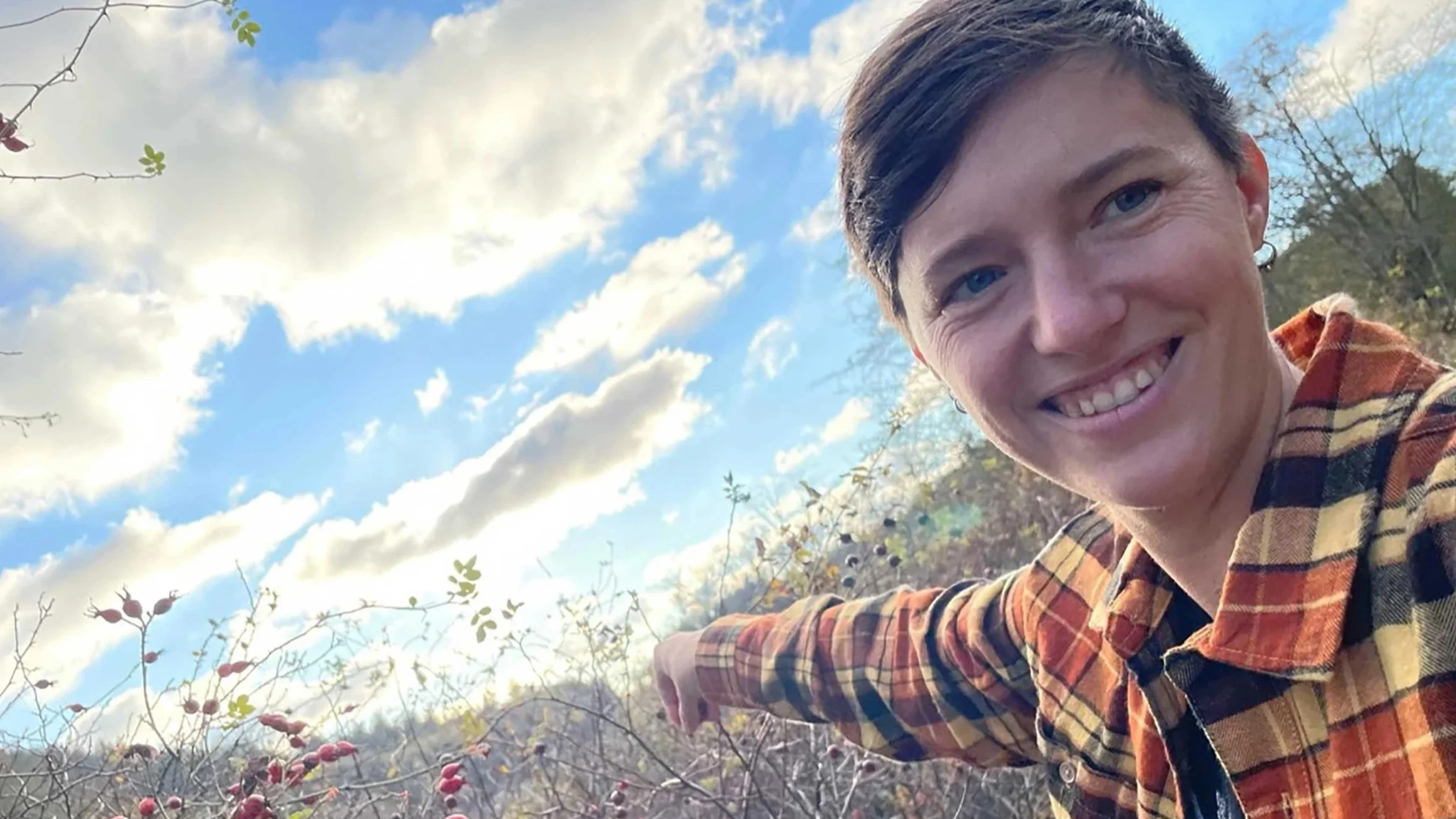
Gowan Batist of Fortunate Farm is a Post-Industrial Pastoralist following sheep around the skeleton of a boom town. She is seldom seen, but sometimes glimpsed with a baby on her back, propagating native plants, spinning wool, hand shearing sheep, or meal prepping baby food with local bulk food via the MendoLake Food Hub.