Tapping into Flow
Managing the Hard Work of Birthing and Farming
by Gowan Batist
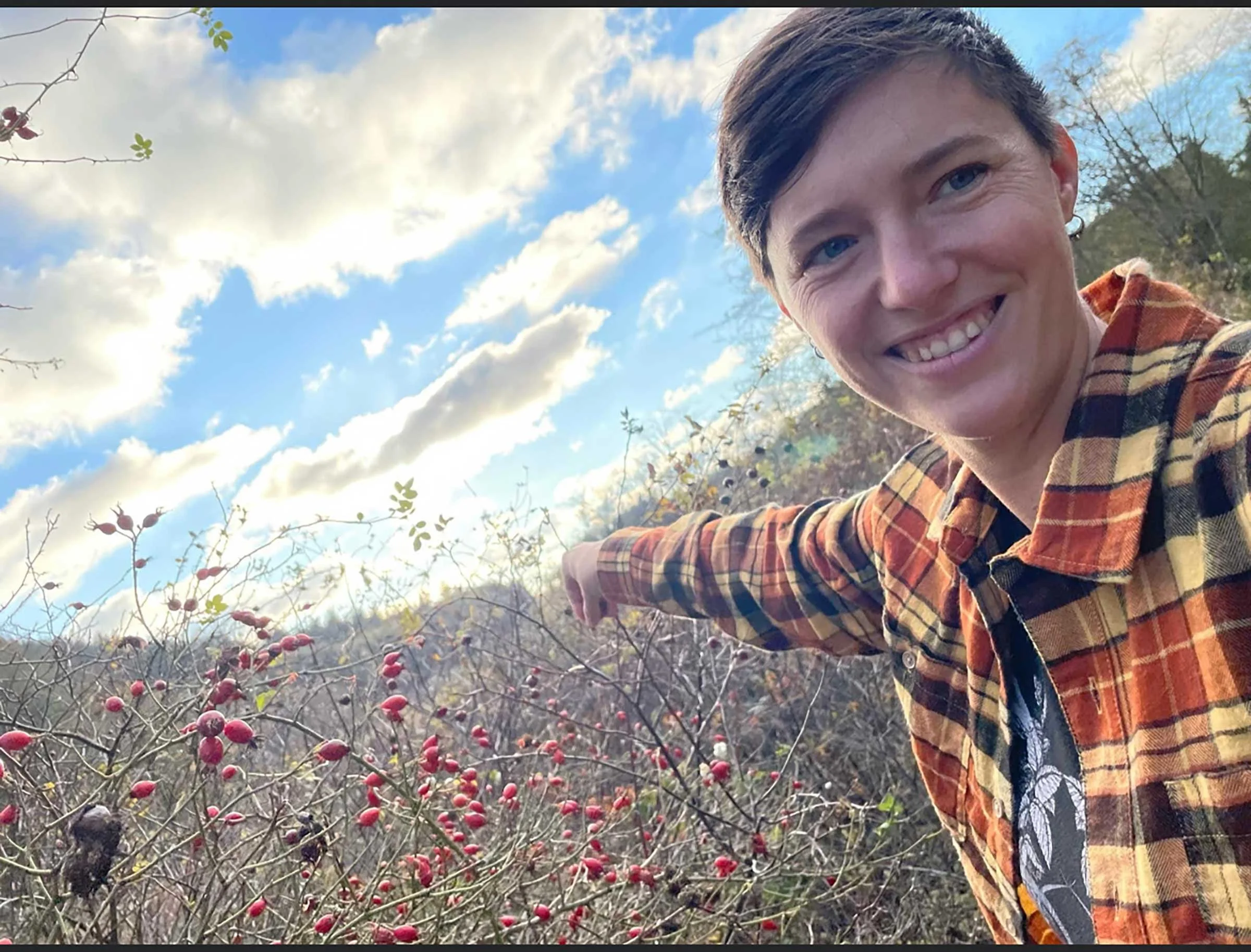
Gowan Batist
Farm work is production work,paid per unit. Because of this inescapable fact, the labor of farming is time bound and repetitive. Even as the landscape around the work is infinitely varied in detail, the same few physical movements are often repeated over and over and over on a daily, weekly, monthly and yearly basis. One amazingly successful market gardener I knew told me about a moment of existential crisis he once had in which he summed up his whole farming career as simply, “I pick things up, and then I put them down.” I’ve often explained vegetable crop work to interns as “a series of specialized squats, many of them weighted.”
Many farmers and ranchers end up curling around whatever form their work takes over time, wearing unevenly like the tools they handle. My own grandfather used to sit at the dinner table near the end of his life, propping his chin up on one hand because his whole body leaned in the direction of his right arm. He had bent in the direction of his labor like a wind-sculpted tree on the bluffs. One of the tasks of our generation and those coming up after us is to break this cycle—regeneration of the landscape should not be at the expense of our spinal discs. For most of us, that requires learning new skills.
I’m not the best teacher of these principles because my body is already formed by injury in ways that make my physical phrasing a little off. I move from my elbow because my wrist doesn’t bend well. I’ve had five surgeries and metal pins hold the bones together. I’m mostly deaf in my right ear too, and I have shoulder, rib, and back injuries. I was raised and trained by chronically injured elderly men who set me on the same trajectory without any malice, but just because they hadn’t learned any other way. I started heavy labor very young and, like everyone around me, I didn’t protect my hearing or my joints, and it shows.
Then I took a hand tools course with John Jeavons on his mountaintop farm, about ten years ago. He explained how work could look without damaging the body, how to hold long-handled tools so that your spine remained straight, and demonstrated how to relax into each movement, letting the weight of your body and the tool do the work, he let soil fall off the straight blade he used to double dig instead of moving with force behind every motion. The way he moved
was fast and efficient while physically he resembled nothing so much as a relaxed and friendly Hobbit.
It was a weekend workshop but had a long-term impact on me. Coupled with lessons learned from the brilliant efficiencies of the Latino harvest crews I worked with in Oregon—picking produce as the sun rose over rows too long to see the ends of—I became a little obsessed with the idea of the “flow state.”
Coined by the positive psychologist Mihály Csíkszentmihályi in his 1975 book Beyond Boredom and Anxiety, the term describes a state of total immersion in a task that comes with a sense of well-being and often a loss of awareness of time passing. The tasks that produce a flow state should be challenging enough to fully demand our attention, but not so challenging as to keep our frontal cortex in a problem- solving or anxious mode. Farming is full of amazing oppor- tunities for flow states. As a farm manager, I was often inter- rupted by deliveries and phone calls and questions, which meant I was even more zealous about the time I got to exist within that flow of work. I guarded it carefully and would try to differentiate between times I was available for chatting and for questions and times I really wanted to sink into the task at hand.
I developed the habit of turning farm tasks into a series of games whose purpose and reward was a state of flow. The method was to move through each task in the most efficient and body-conscious way I could, until each breath was coordinated with the movements, and all tension melted away. Harvesting kale? Step to the side, breathe out, bend at the waist with a flat back, crack both hands sharply down around the crown of the frilly growing plant, breathe in as you stand up with a bunch in each hand, twirl bands off each wrist, flip into the waxed box on the cart ahead of you, and take another sideways step, pushing the cart another foot or so ahead. Repeat until the boxes are full, the order sheets are ticked off, the sun is rising high, and your head is pleasantly empty.
Every farm task, approached systematically, can lead you to this place, and paradoxically the feeling of timelessness, or even time dilation, results in work that is very fast. Shearing sheep is also a fantastic opportunity for flow. It requires careful attention and physical commitment, but when the work is moving smoothly, it can feel like being drawn along rather than putting forth effort—like being pulled rather than pushing. I’ve felt the same thing transplanting— the sense that the row was drawing me down it, of falling into the motions without effort, rather than me hauling my body and tools and flats of seedlings across the ground. It’s like the energy of the task and the movement, especially when working nearby but not directly with other people, becomes a stream that we’re floating on. It would take more effort to clamber up out of it than it does to continue. When you finally do stop, there’s a moment of readjustment like stepping onto solid ground off of a boat. Your footfalls hit heavier and with more finality, and with the loss of that buoyancy, you become aware that you are tired.
For me, giving birth was like this. A series of repetitive tasks that required my whole attention and engagement, that needed to be relaxed and breathed into as deeply as possible. It was another game of efficiency, of finding every little hidden snarl of resistance or tension within myself and releasing it. The difference was the degree of intensity. If transplanting lettuce starts was like being gently drawn downstream by a friendly river, birth for me was like whitewater rafting. The force of the river I was inside of was so huge and powerful, I knew instinc- tively that if I panicked and tried to resist it, and got my little boat turned sideways in an attempt to escape, it would roll over me, overwhelm me, and crush me.
On the other hand, if I looked ahead at where the river was taking me, leaned my weight thoughtfully along with it, relaxed every muscle I could so that my hands didn’t give out white-knuckling the paddle, I could be carried along with it and it could be exhilarating, powerful, and even incredibly fun. I had the sense of both working very hard, but also being carried by the work. My main job was to remove all obstacles between myself and the incredible power that was flowing through and with me.
In my partner Hunter’s birth notes there’s an entry stating “1:20pm. Gowan rolls over and says, ‘This is so cool!’” This was followed by active pushing at 1:30pm, and then the
arrival of our baby. I experienced the transition as euphoric and exultant. This was a combination of extremely good luck, privilege to have access to midwife care and also, I think, decades of learning to be with my body in a state of flow under conditions of hard work.
I had pictured being very active during labor. I had subscribed to a bunch of health and fitness programs that showed beautiful mothers engaged in all sorts of lunges and squats and dance routines (all with perfect hair) as their birth unfolded. I didn’t have time for any of that. My birth was fast and furious, and I think if I hadn’t had those lessons in letting gravity and relaxation move my body through manual labor gently, I would have been tempted to try to cling onto the ride for dear life instead of softening into it. In a very real way, learning to double dig—a manual soil-preparation method I have not used since that workshop ten years ago—facili- tated our baby’s birth more than the Miles Circuit or Spinning Babies videos I watched.
As I write this, our apples are small and hard on the tree, our raspberries are just beginning to ripen ahead of the major crop in the fall, and our elderberry flowers are crisping up and drawing back to become berries. Our kale and broccoli are still luxuriantly large and tender ahead of the hot weather. The birth of our second child is imminent, sometime between tonight and the next few weeks. Every day, my practice contractions feel less like practice and more like the headwaters of a river about to spring free. The baby is kicking my ribs and nestling into my pelvis, to the point that when I walked with our flock across the pasture, leading the way to new grass for the last time in a while, I could feel the round weight so low in my hips I had to sway around it. The sheep brushed their woolly sides against my legs in companionship. It’s nothing they haven’t seen before.
I’m heading back into that internal liminal space, ready for another trip down the river. Who knows if this ride will be slow and meandering, or another whitewater adventure. Either way, I’m excited. Take care of the outside world while I’m away, and while you do, remember your posture and breathing as you move down the rows, over the fields, and reach up into your trees, and thank your farming teachers. You might find yourself relying on them in ways radically different than you expected, years down the road.
Gowan Batist of Fortunate Farm is a Post-Industrial Pastoralist following sheep around the skeleton of a boom town. She is seldom seen, but sometimes glimpsed with a baby on her back, propagating native plants, spinning wool, hand shearing sheep, or meal prepping baby food with local bulk food via the MendoLake Food Hub.